
What materials are used in professional-grade printing consumables?
Direct Answer
Professional-grade digital printing consumables are engineered from high-purity raw materials: PET film with specialized ink-receptive coatings for DTF, water-based pigment inks with sub-micron particle dispersion for all digital textile applications, TPU (thermoplastic polyurethane) hot-melt powder for DTF adhesion, disperse dye inks on coated transfer papers for sublimation, and UV-curable monomer-based inks for rigid substrate printing. The quality of these raw materials directly determines print vibrancy, wash durability (50-100+ cycles), and production consistency.
Professional Printing Consumables: A Material-by-Material Guide
DTF (Direct-to-Film) Consumables
DTF printing relies on three core consumable materials that must work in precise chemical harmony. Using mismatched or low-grade materials in any one category will compromise the entire transfer:
DTF Transfer Film
The foundation of every DTF print. Professional-grade DTF film is made from PET (polyethylene terephthalate) with a specialized matte ink-receptive coating on the print side. Two standard thicknesses dominate the market:
- 75 m (microns): The industry standard for everyday apparel printing. Offers excellent flexibility and soft hand-feel, suitable for t-shirts, hoodies, and tote bags across cotton, polyester, and blended fabrics.
- 100 m (microns): Heavy-duty film with a thicker coating layer for high-ink-density designs, canvas bags, workwear, and applications requiring maximum wash durability.
Film quality indicators include coating uniformity (ensures razor-sharp fine lines without ink bleeding), clean powder release (powder adheres only to printed areas, not blank film), and smooth peel performance (hot-peel for high-volume production speed, cold-peel for maximum detail and durability on premium products). Top-tier brands like Kodak Kodacolor and STS Inks produce films with anti-static treatment and thermal stability that prevent curling during the curing process.
DTF Inks (CMYK + White)
Professional DTF inks are water-based pigment dispersions with particle sizes below 0.5 m, processed through nano-grinding and micro-filtration to ensure smooth jetting through printhead nozzles as small as 20 m (Epson DX5/i3200). The ink formulation contains:
- Pigments: Provide color. White ink uses titanium dioxide (TiO) at high concentration for maximum opacity, which is critical as the white underbase layer that makes CMYK colors pop on dark fabrics.
- Binder resins: Acrylic or polyurethane polymers that bond pigment to the film and fabric, providing flexibility and wash resistance.
- Co-solvents: Glycol-based compounds (ethylene glycol, propylene glycol) that control viscosity to the ideal range of 3-5 mPa-s at room temperature and prevent nozzle drying.
- Surfactants and additives: Surface tension modifiers for precise droplet formation, biocides to prevent bacterial growth, and anti-settling agents (particularly critical for white ink due to TiO's high specific gravity).
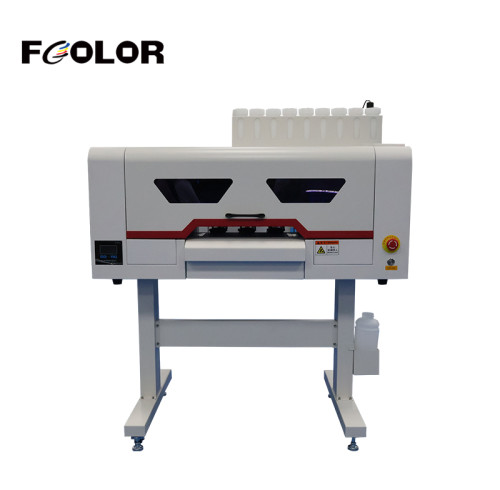
White ink requires special attention: TiO particles are denser than CMYK pigments and will settle within 24-48 hours if not agitated. Professional print shops shake white ink cartridges daily, and production-grade DTF printers from manufacturers like FCOLOR include integrated white ink circulation systems that maintain consistent pigment suspension throughout the print run. Certified inks carrying the OEKO-TEX Eco Passport guarantee skin safety and absence of harmful substances.
DTF Hot-Melt Adhesive Powder
The bonding agent that permanently fuses the printed design to fabric fibers. Professional DTF powder is 100% TPU (thermoplastic polyurethane) resin, ground to controlled particle size ranges:
- Fine powder (50-100 m): Ultra-thin, ultra-soft coating ideal for fashion t-shirts, detailed logos, and photo-realistic prints. Delivers the softest hand-feel with no tactile difference on the fabric.
- Medium powder (70-170 m): The universal all-purpose grade. Provides strong adhesion across cotton, polyester, and blends, suitable for t-shirts, sweatshirts, and canvas bags.
- Coarse powder (170-300 m): Maximum adhesion strength for heavy-duty applications including work uniforms, sports jerseys, nylon fabrics, and high-abrasion environments.
Specialized variants include anti-sublimation black powder (prevents dye migration from polyester fabrics) and stretch powder (maintains flexibility on spandex-blend activewear). Always verify OEKO-TEX Eco Passport certification when sourcing powder for garments that contact skin.
Dye-Sublimation Consumables
Sublimation printing uses fundamentally different chemistry from DTF, relying on dye transformation rather than surface adhesion:
- Sublimation ink: Aqueous disperse dye inks engineered for Epson MicroPiezo printheads. When heated to 380-400F (193-204C), the solid dye particles sublimate directly into a gas and bond at the molecular level with polyester fibers. Unlike pigment inks that sit on the surface, sublimation dyes become part of the material itself, resulting in prints that never crack, peel, or fade.
- Sublimation transfer paper: Specialized paper with a clay-coated or resin-coated release layer that holds ink on the surface (not absorbed into the paper fibers), maximizing dye transfer efficiency during pressing. High-quality papers achieve 90-97% transfer rates, while budget papers may only transfer 70-80%, wasting ink and producing faded results.
- Substrate requirement: Sublimation only bonds to polyester or polymer-coated surfaces. It will not work on 100% cotton, untreated wood, or uncoated metals. This is a fundamental chemical constraint, not a quality issue.
UV Printing Consumables
UV-curable printing operates on an entirely different principle: liquid monomers that polymerize instantly under UV light exposure:
- UV-curable inks: Composed of acrylate monomers and oligomers, photoinitiators, and pigments. When exposed to UV-LED light (typically 385-395nm wavelength), photoinitiators trigger an instantaneous polymerization reaction that transforms the liquid ink into a solid, durable film. This allows printing on virtually any rigid or flexible substrate: acrylic, metal, glass, wood, plastic, and ceramics.
- UV DTF film: A specialized PET film variant with a UV-receptive coating designed to release cured UV ink onto three-dimensional objects (phone cases, water bottles, curved surfaces) when combined with a laminating adhesive layer.
- Cleaning solutions: UV inks are particularly prone to curing inside printheads if maintenance is neglected. Dedicated UV printhead flush solutions and regular cleaning cycles are non-negotiable consumables, not optional extras.
DTG (Direct-to-Garment) Consumables
- DTG pigment inks: Similar water-based pigment chemistry to DTF inks but formulated for direct fabric absorption rather than film transfer. Typically CMYK plus 2-4 white channels for opacity on dark garments.
- Pretreatment solution: A critical chemical primer applied to cotton garments before printing. This solution chemically bonds with cotton fibers to create a receptive surface that prevents white ink from absorbing too deeply into the fabric, ensuring bright, opaque whites. Using the wrong pretreatment or skipping this step entirely is the leading cause of DTG print failures.


Quality Indicators: What Separates Professional-Grade from Budget Consumables
| Quality Metric | Professional Grade | Budget/Generic |
|---|---|---|
| Ink particle size | <0.5 m, uniform dispersion | 0.8-2 m, inconsistent |
| Wash durability | 50-100+ cycles | 10-30 cycles |
| Color gamut | Wide gamut, accurate ICC profiles | Narrow gamut, no profile support |
| Film coating uniformity | 0.5 m tolerance | 2-5 m variation |
| Certifications | OEKO-TEX Eco Passport, CPSIA compliant | None or unverified claims |
| White ink opacity | Single pass, >90% coverage | 2-3 passes required |
| Storage stability | 9-12 months (CMYK), 6 months (white) | 3-6 months, unpredictable settling |
The Impact of Material Quality: A Production Comparison
A mid-size custom apparel business switched from generic unbranded DTF consumables to a matched system from a single certified manufacturer. The results over six months of production:
- Print defect rate dropped from 6.8% to 1.1%
- Customer returns due to peeling/fading decreased by 82%
- White ink consumption per shirt reduced by 35% due to higher opacity requiring fewer passes
- Monthly printhead replacement costs fell from $840 to $210 because properly formulated inks caused less clogging
FCOLOR supplies professional-grade consumables engineered as a complete system, where film, ink, and powder are formulated to work together for predictable, repeatable results. This system-level approach eliminates the trial-and-error that comes from mixing consumables from disparate suppliers.
Storage and Handling Best Practices
Professional consumables are chemically active products with finite shelf lives. Proper storage preserves performance and prevents waste:
- Temperature: Store all consumables at 10-30C (50-86F). Avoid garage or warehouse storage in extreme climates.
- Humidity: Maintain 40-60% relative humidity in the print room. High humidity causes film coatings to absorb moisture, leading to ink bleeding; low humidity increases static electricity that attracts dust to films.
- Light protection: Store films in their original black packaging bags. UV exposure degrades ink-receptive coatings over time.
- White ink agitation: Shake or recirculate white ink at least once per week (daily for high-volume production). Sedimented TiO can permanently clog printheads.
- Powder sealing: Keep hot-melt powder in airtight containers with silica gel desiccant packs. Moisture absorption causes clumping that ruins powder distribution and curing consistency.
- Cross-contamination prevention: Physically separate powder-shaking areas from film storage and printing stations. Airborne powder particles settling on unprinted film create permanent defects.
Related Questions
Are you looking for a reliable manufacturer of inkjet ink and printer products?
We can quickly provide customers with market analysis, technical support and customized services.

- Name
- Phone
- *Title
- *Content