
OEKO-TEX ECO PASSPORT Certified DTG Inks: What It Means for Your Textile Printing Business
When international buyers evaluate textile printing ink suppliers, the conversation quickly moves from price and color gamut to one decisive question: Can you prove your inks are safe? The OEKO-TEX® ECO PASSPORT is the certification that answers that question at the chemical-input level. Unlike labels that only describe a finished garment, ECO PASSPORT verifies the inks, pigments, and chemical auxiliaries before they enter production.
For DTG, DTF, and digital textile printing businesses, this certification is not a marketing add-on. It is a procurement passport into regulated markets, a risk-mitigation tool, and a trust signal that large brands and end consumers understand instantly. In this article, we explain what ECO PASSPORT means, how it works, and why Fullcolor Technology Limited’s certified printing inks can strengthen your supply chain.
What Is OEKO-TEX ECO PASSPORT and Why Does It Matter for Textile Printing Inks?
OEKO-TEX® ECO PASSPORT is an independent, multi-stage testing and certification system for chemicals, colourants, and auxiliaries used in the textile and leather industries. Issued by OEKO-TEX® member institutes such as Hohenstein Laboratories in Germany, the certification confirms that every ingredient in a chemical product has been screened against restricted substances and meets strict human-ecological and regulatory requirements.
For ink manufacturers, this matters because textile inks are not just colored liquids. They contain pigments, binders, wetting agents, dispersants, and additives that can carry residual heavy metals, formaldehyde, phthalates, or volatile organic compounds if uncontrolled. ECO PASSPORT removes that uncertainty by testing the formulation itself, giving downstream printers and apparel brands confidence that the chemical inputs are compliant before a single garment is printed.
How OEKO-TEX ECO PASSPORT Certification Works: The Three-Stage Testing Process
ECO PASSPORT certification is modular. A product can progress through multiple stages, and each stage adds a deeper layer of verification. The process is overseen by OEKO-TEX® institutes and is recognized by the ZDHC Roadmap to Zero programme from Level 1 to Level 3.
- Stage 1 — CAS Number Screening and Self-Assessment: Every ingredient is compared against the ECO PASSPORT Restricted Substances List (RSL), the STANDARD 100 RSL, the STeP MRSL, and the REACH SVHC candidate list. The applicant also completes a self-assessment covering quality, environmental, health and safety, and social responsibility practices. Completion of this stage qualifies for ZDHC MRSL Level 1.
- Stage 2 — Analytical Verification and On-Site Visit: An OEKO-TEX® laboratory tests the chemical product for restricted substances. An on-site audit then confirms that the declared manufacturing conditions match reality. This stage qualifies for ZDHC MRSL Level 2.
- Stage 3 — Chemical Hazard Assessment (CHA): The highest tier includes a full chemical hazard assessment to evaluate risks to human health and the environment. This stage qualifies for ZDHC MRSL Level 3 and is also recognized under the ZDHC Chemicals to Zero Progressive (CtZ-P) level.
The certificate is valid for one year and must be renewed with updated testing, ensuring that formulations continue to meet the latest scientific and regulatory limits.
OEKO-TEX ECO PASSPORT vs. STANDARD 100: What Is the Difference for Ink Suppliers?
Both certifications belong to the OEKO-TEX® family, but they answer different questions. Understanding the difference is essential when buyers ask for proof of compliance.
| Question | OEKO-TEX® STANDARD 100 | OEKO-TEX® ECO PASSPORT |
|---|---|---|
| What is certified? | The finished textile product | Chemical inputs such as inks, dyes, and auxiliaries |
| Scope for printers | Tests the printed garment against skin contact limits | Tests the ink formulation before it reaches the printer |
| Best used for | End-product claims and retail labels | Supplier qualification and chemical sourcing |
| ZDHC alignment | Not directly mapped | Recognized for ZDHC MRSL Levels 1–3 |
| Renewal | Annual re-testing of finished product | Annual re-testing of chemical formulation |
For a DTG or DTF printing business, ECO PASSPORT is the upstream proof that the inks you use will not sabotage a downstream STANDARD 100 test on the finished garment. It shortens certification paths and reduces the risk of unexpected chemical failures.
What ZDHC MRSL 3.1 Level 3 Conformance Means for Your Supply Chain
The ZDHC Manufacturing Restricted Substances List (MRSL) is the foundation of the Zero Discharge of Hazardous Chemicals (ZDHC) Roadmap to Zero programme. Unlike traditional Restricted Substances Lists that test finished products, the ZDHC MRSL targets chemicals at the beginning of the manufacturing process. This upstream approach prevents harmful substances from entering production in the first place, protecting workers, communities, and ecosystems.
ZDHC MRSL Version 3.1 sets maximum concentration limits for restricted substances and is updated through a transparent, science-based process involving independent experts and industry stakeholders. Conformance is divided into three levels:
- Level 1: CAS number screening and self-assessment confirm that no intentionally used restricted substances exceed the limits.
- Level 2: Adds analytical laboratory verification and an on-site visit to confirm data and practices.
- Level 3: Adds a chemical hazard assessment (CHA), representing the highest standard for safer chemistry and qualifying for ZDHC Chemicals to Zero Progressive (CtZ-P).
Achieving ZDHC MRSL 3.1 Level 3 means the certified ink has passed the most rigorous evaluation available under the programme. For buyers, this removes the need to perform duplicate chemical due diligence and signals that the supplier operates at the top tier of sustainable chemistry.
Why Global Brands and Print Service Providers Demand OEKO-TEX Certified Inks
Certified inks have moved from a nice-to-have to a baseline requirement in premium apparel, promotional merchandise, and home textile supply chains. Here are the four drivers behind that shift.
Regulatory Access
ECO PASSPORT aligns with EU REACH Annexes XVII and XIV, the US CPSIA, and the ECHA-SVHC candidate list. Using certified inks reduces the risk of customs detention, shipment rejection, and regulatory penalties in major export markets.
Brand Sustainability Mandates
Leading apparel brands require PFAS-free, phthalate-free, and formaldehyde-free inputs. ECO PASSPORT provides independently verified documentation that supports brand ESG and sustainability commitments.
Faster Supplier Qualification
Buyers can verify a certificate by its number or QR code. This transparency shortens audit cycles and helps certified suppliers advance to the shortlist while uncertified competitors are filtered out.
Worker and Consumer Safety
Printers handle inks daily. Certified formulations reduce operator exposure to hazardous vapors and particles, while end consumers receive garments that meet internationally recognized safety standards.
Fullcolor Technology Limited: Our OEKO-TEX ECO PASSPORT for Printing Inks
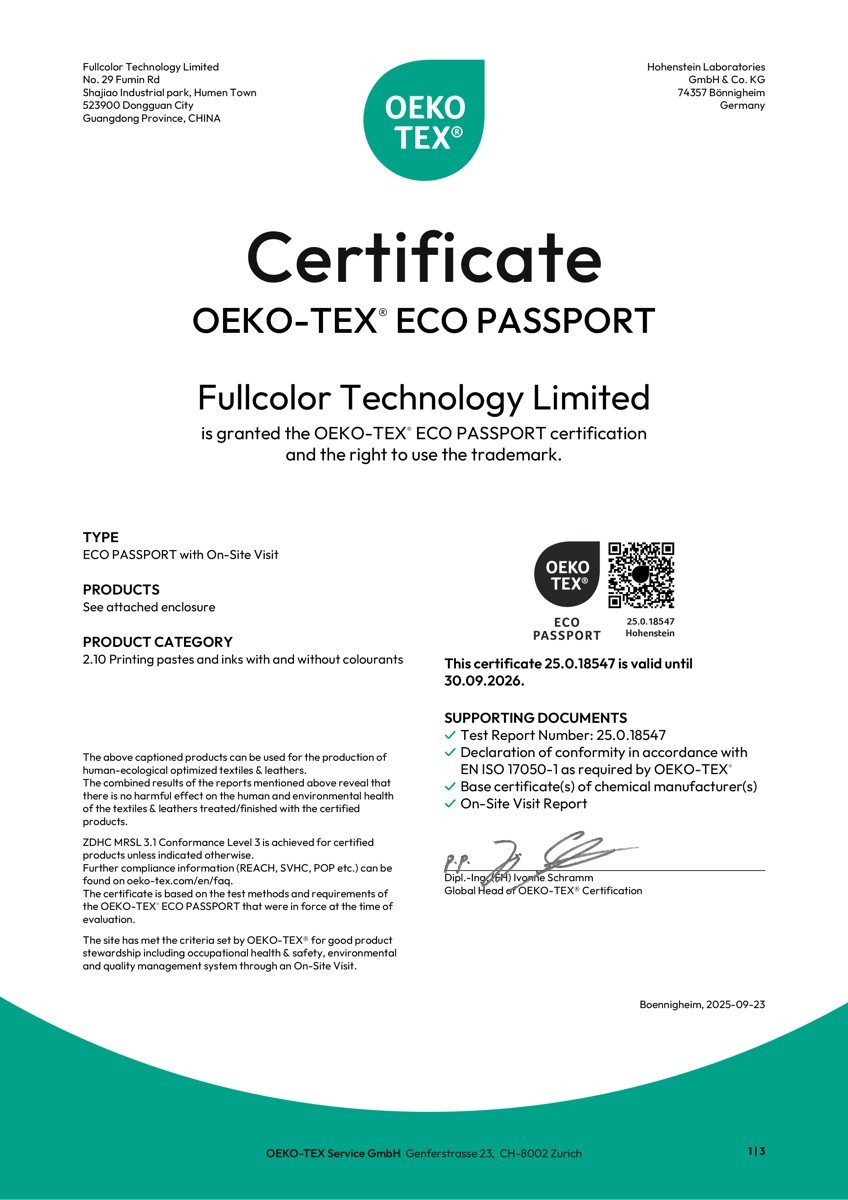
Fullcolor Technology Limited has been awarded the OEKO-TEX® ECO PASSPORT certification by Hohenstein Laboratories, one of the founding OEKO-TEX® institutes. The certificate covers product category 2.10 Printing pastes and inks with and without colourants, confirming that our ink formulations meet strict chemical safety requirements for textile and leather applications.
Certificate holder: Fullcolor Technology Limited
Certificate number: 25.0.18547
Certification type: ECO PASSPORT with On-Site Visit
Valid until: 30 September 2026
Product category: 2.10 Printing pastes and inks with and without colourants
ZDHC MRSL conformance: Level 3
The certificate explicitly states that the certified products can be used for the production of human-ecological optimized textiles and leathers, and that the combined test results reveal no harmful effect on the human and environmental health of textiles treated or finished with the certified products. This is the exact assurance that downstream printers, garment factories, and brand compliance teams need.

How OEKO-TEX ECO PASSPORT Inks Improve Product Safety and Sustainability
Choosing ECO PASSPORT certified inks creates measurable benefits across the product lifecycle. These benefits go beyond compliance and directly affect product quality, operational risk, and market positioning.
Practical Benefits of Certified Textile Printing Inks
Verified Chemical Safety
Every batch starts from a formulation that has passed CAS screening, analytical testing, and hazard assessment, reducing the risk of unexpected restricted substances.
Easier Market Entry
Certified inks smooth the path to EU, North American, and Japanese markets where chemical compliance is routinely checked at import and retail levels.
Brand Qualification
Large-volume buyers use certifications as a first-pass filter. ECO PASSPORT helps ink suppliers and their printer partners stay on the approved vendor list.
Lower Recall Risk
Third-party verified chemical safety reduces the probability of product recalls, customer claims, and supply chain disruptions caused by failed chemical tests.
ECO PASSPORT also integrates with the broader OEKO-TEX® modular system. Certified chemicals can simplify downstream applications for STANDARD 100, STeP, and LEATHER STANDARD, potentially reducing testing costs and lead times for finished products.
How to Verify an OEKO-TEX ECO PASSPORT Certificate for Your Ink Supplier
Verifying a certificate takes only a few minutes and should be a standard step in any supplier qualification process. Follow these steps to confirm that an ECO PASSPORT certificate is genuine and current:
- Step 1 — Request the certificate number and PDF: A legitimate supplier will provide the certificate number, the issuing OEKO-TEX® institute, and the expiry date. Fullcolor’s certificate number is 25.0.18547.
- Step 2 — Check the OEKO-TEX® Buying Guide: The official OEKO-TEX® Buying Guide lists certified companies and products. Search by company name or certificate number to confirm active status.
- Step 3 — Scan the QR code on the certificate: Original certificates include a QR code that links to the OEKO-TEX® verification system. Scanning it should return the certificate details, validity period, and product scope.
- Step 4 — Confirm the product category: Make sure the certificate covers the product category relevant to your application. For textile printing inks, the relevant category is 2.10 Printing pastes and inks with and without colourants.
- Step 5 — Check the expiry date: ECO PASSPORT certificates are valid for one year. A certificate that is expired or about to expire should be renewed before placing large orders.
Taking these steps protects your business from counterfeit claims and ensures that the inks you purchase will support, rather than undermine, your own product safety and sustainability commitments.
Partner with Fullcolor for Compliant, High-Performance Textile Printing Inks
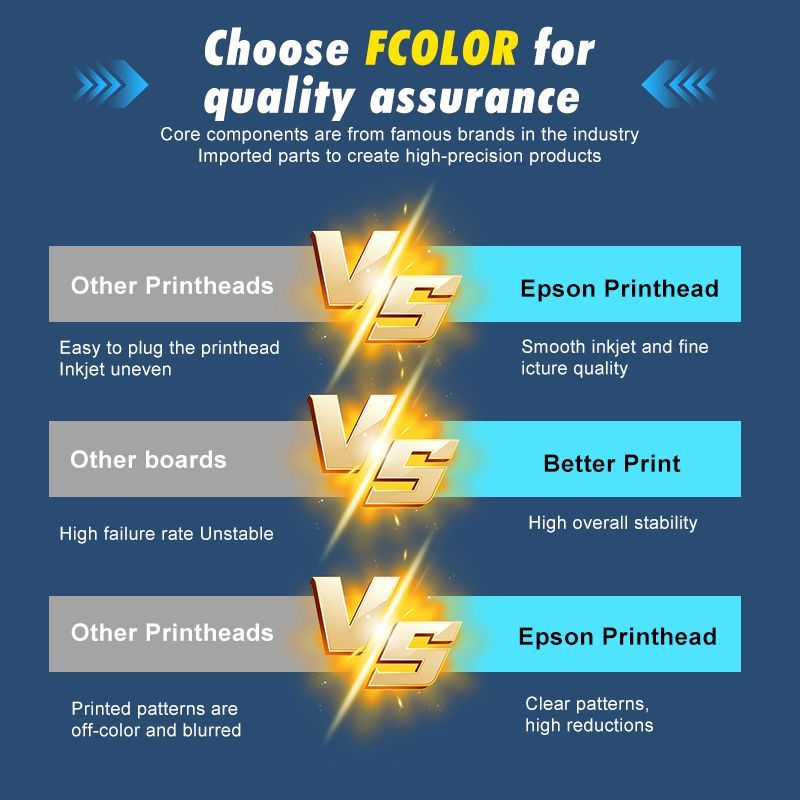
Fullcolor Technology Limited combines certified chemical safety with practical printing performance. Our ECO PASSPORT certified inks are formulated for DTG, DTF, and digital textile applications where color vibrancy, wash durability, and regulatory compliance are all non-negotiable.
When you source from Fullcolor, you receive:
- Inks certified under OEKO-TEX® ECO PASSPORT with On-Site Visit
- ZDHC MRSL 3.1 Level 3 conformance for the highest level of chemical safety recognition
- Transparent certificate documentation for your own buyer audits and compliance files
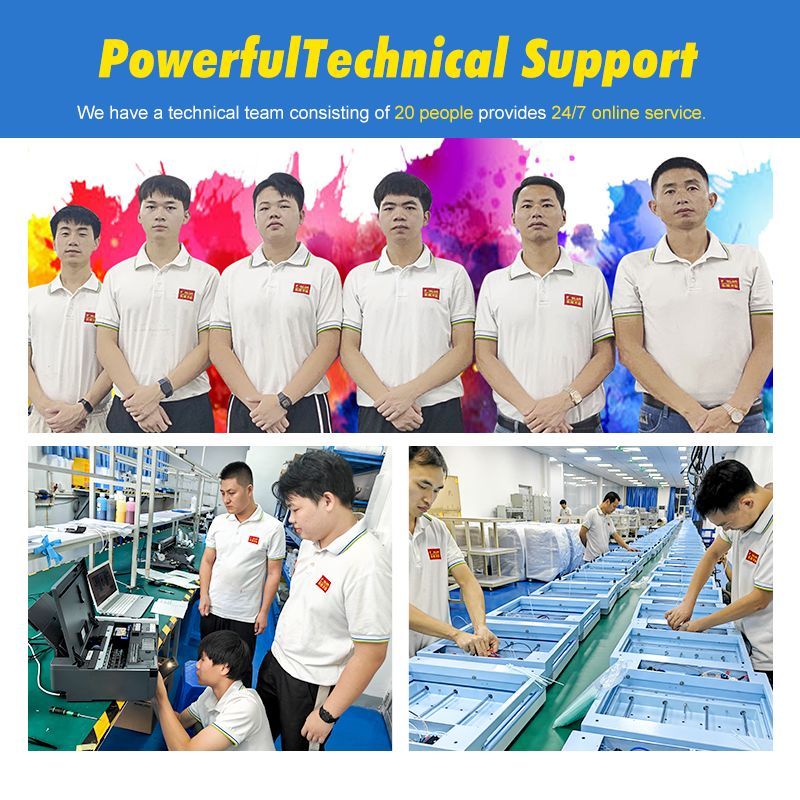
- Technical support to match ink formulations with your printer model and fabric substrate
- A renewal commitment that keeps certificates active and aligned with the latest OEKO-TEX® standards
Certification is not a one-time event at Fullcolor. It is part of our operating standard. We maintain it because our customers—garment decorators, promotional product suppliers, fashion brands, and industrial textile printers—depend on it to win and keep high-value accounts.
Learn more about Fullcolor’s certified textile printing inks or contact our team to request the full certificate documentation and technical data sheets for your market.